IMMERSE: Meet the Allies
Mediterranean sea salt, Dead Sea salt, and Epsom salt (Bath Brew)
Three salts, each doing different work. Dead Sea salt brings the mineral density — one of the highest concentrations of naturally occurring minerals found in any body of water on earth. Mediterranean salt is clean and white, the purest register of sea mineral. Epsom is magnesium sulfate, used for centuries to ease tension held in the muscle. Dendritic salt carries the scent until the moment you pour.
Fine sea salt, Epsom salt, coarse sea salt, and dendritic salt (Shower Steamer)
A lighter salt architecture for brief exposure. The coarse crystals slow the dissolve; the dendritic holds the scent through the steam.
French green clay
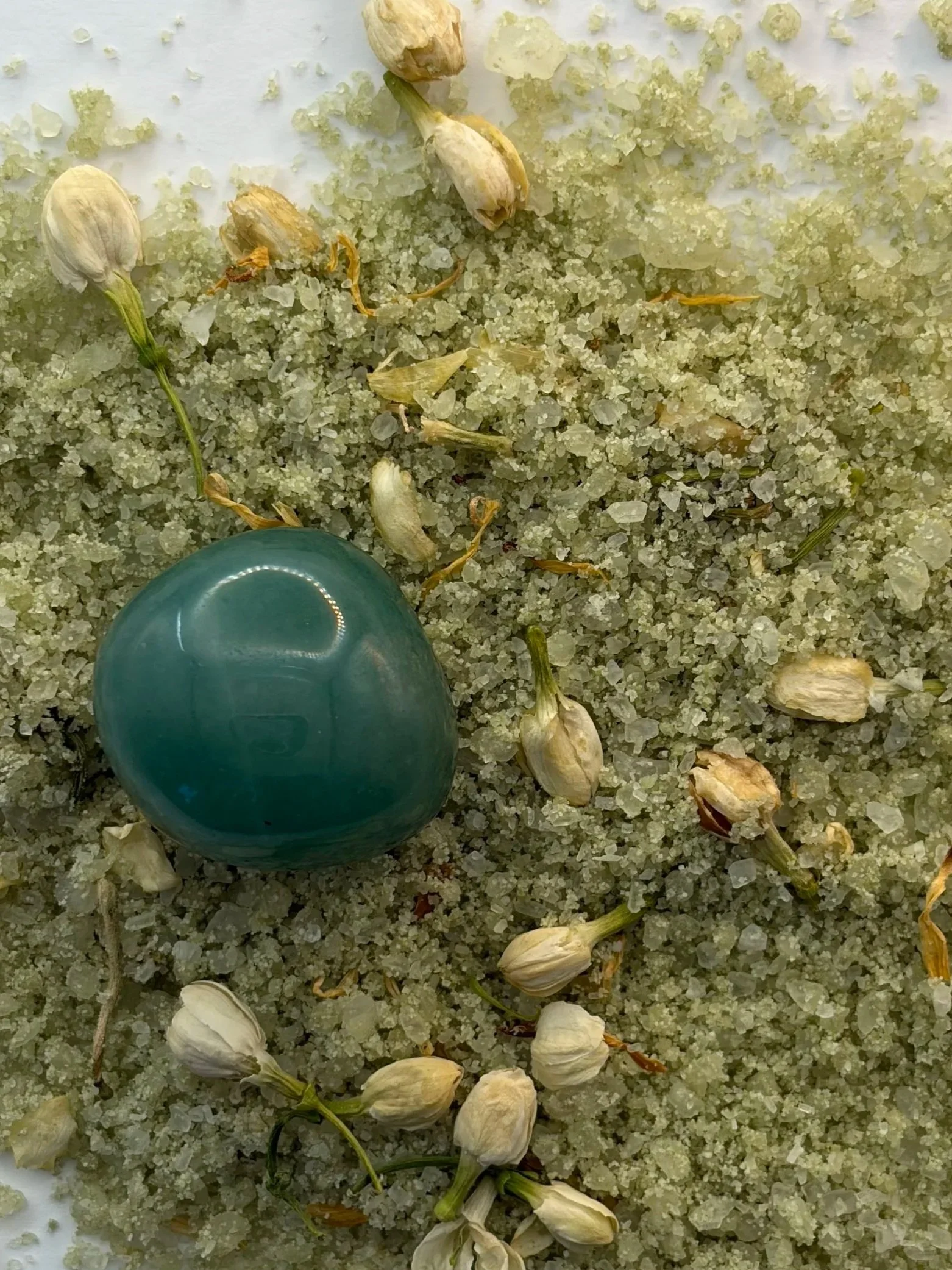
Illite — a naturally occurring mineral clay with a faint olive-green color, formed in ancient seabeds. French green clay has been used in therapeutic bathing and skin care for centuries, valued for its drawing and mineralizing properties. In this blend it does something subtler — it tints the salt base the faintest olive-green, creating a visual coherence with the green aventurine stones and the green-floral register of the scent. The mineral family runs through every layer of this jar: clay, stone, water. Everything here is from the earth. (In the Shower Steamer, it creates a warm olive-green floor.)
Jasmine buds and honeysuckle buds
Jasminum sambac and Lonicera japonica — two flowers kept close across cultures for their scent and their quiet. Dried jasmine buds are pale ivory; honeysuckle buds cream-white. Together they form the botanical ground of this blend — delicate, restrained, present. You see them before you smell them. Then the water opens.
Calendula petals (Bath Brew · Shower Steamer)
Calendula officinalis — the pot marigold, warm amber-gold, cultivated as a healing plant across Europe and the Mediterranean for centuries. Calendula is one of the most well-documented skin-soothing plants in Western herbal tradition. Its petals dry into warm gold and hold their color reliably. In the jar they thread warmth through the cooler ivory and green — a gold thread through an earthy field.
The scent blend
No single oil is recognizable on its own. That's by design — this formula was built as a synergy, not a composition with a lead. Roman chamomile opens the bath formula: apple-green warmth, faintly sweet, the smell of something growing rather than cut. Palmarosa moves through the heart — rosy and green at once, a brightness that keeps the blend alive without lifting it into citrus territory. Ylang ylang hovers at the edge, kept deliberately low; it adds a floral depth without tipping into excess. Laurel brings a spiced-green backbone, herbal and grounded. Frankincense sacra sits in the foundation as quiet resin. Patchouli anchors everything — dark earth beneath the green-floral world, the thing that keeps this blend from floating away. Cardamom threads through the whole formula: warm, spiced, alive. The jasmine absolute arrives in the dry-down of the body oil and butter — you may not name it. You'll feel it.
The shower formula opens differently — petitgrain and lavender lead, grounding the steam before the green-floral heart arrives. German chamomile joins Roman here, adding a blue-green depth that the bath formula carries through clay instead.
Green aventurine (Bath Brew only)
A form of quartz with fuchsite mica inclusions that give it its distinctive green shimmer.
Green aventurine completes the mineral triangle in this jar alongside amazonite and clear quartz. It has been associated in many traditions with calm, openness, and the capacity to receive — all qualities that belong to this stage of the arc. In the bath, the green stones, the olive-tinted salt, and the warm calendula gold create a depth of color that looks like something the earth made on purpose.
FULL INGREDIENTS LIST
IMMERSE Ritual Bath Brew
1
Maris Sal, Sodium Chloride, Magnesium Sulfate, Kaolin, Jasminum Sambac Flower, Lonicera Japonica Flower, Calendula Officinalis Flower, Cymbopogon Martinii Oil, Cananga Odorata Flower Oil, Anthemis Nobilis Flower Oil, Laurus Nobilis Leaf Oil, Boswellia Sacra Oil, Pogostemon Cablin Oil, Elettaria Cardamomum Seed Oil, Caprylyl Glucoside
IMMERSE Ritual Shower Steamer
2
Magnesium Sulfate, Sodium Chloride, Kaolin, Jasminum Sambac Flower, Lonicera Japonica Flower, Calendula Officinalis Flower, Citrus Aurantium Amara Leaf Oil, Lavandula Angustifolia Oil, Cymbopogon Martinii Oil, Cananga Odorata Flower Oil, Matricaria Chamomilla Flower Oil, Anthemis Nobilis Flower Oil, Laurus Nobilis Leaf Oil, Boswellia Sacra Oil, Pogostemon Cablin Oil, Elettaria Cardamomum Seed Oil, Caprylyl Glucoside
IMMERSE Body Oil
3
Prunus Amygdalus Dulcis Oil, Prunus Armeniaca Kernel Oil, Persea Gratissima Oil, Simmondsia Chinensis Seed Oil, Argania Spinosa Kernel Oil, Tocopherol, Cymbopogon Martinii Oil, Cananga Odorata Flower Oil, Matricaria Chamomilla Flower Oil, Anthemis Nobilis Flower Oil, Laurus Nobilis Leaf Oil, Boswellia Sacra Oil, Pogostemon Cablin Oil, Jasminum Sambac Flower/Leaf Extract, Elettaria Cardamomum Seed Oil
IMMERSE Body Butter
4
Theobroma Cacao Seed Butter, Butyrospermum Parkii Butter, Cetearyl Olivate, Sorbitan Olivate, Glycerin, Prunus Amygdalus Dulcis Oil, Cymbopogon Martinii Oil, Cananga Odorata Flower Oil, Matricaria Chamomilla Flower Oil, Anthemis Nobilis Flower Oil, Laurus Nobilis Leaf Oil, Boswellia Sacra Oil, Pogostemon Cablin Oil, Jasminum Sambac Flower/Leaf Extract, Elettaria Cardamomum Seed Oil