VISION: Meet the Allies
Dead Sea salt and Epsom salt (Bath Brew)
A grey-mineral base that reads like altitude and ground in the same palette, with dendritic salt to carry the scent.
Dead Sea salt's grey-mineral character is doing something specific here — it carries the visual register of stone and high places without introducing warmth. Epsom salt lightens the base without sweetening it. Together they create a field that lets the blue cornflower read as vivid without competing. The palette is deliberate: grey ground, vivid blue, gold thread. Everything in service of clarity.
Fine sea salt, Epsom salt, coarse sea salt, and dendritic salt (Shower Steamer)
A lighter salt architecture for brief exposure. The coarse crystals slow the dissolve; the dendritic holds the scent through the steam.
Cambrian blue clay
A rare naturally occurring clay with a blue-grey mineral color, sourced from Baltic and Russian mineral deposits formed in ancient halite — salt formations hundreds of millions of years old. Its color is entirely natural — no dyes, no additives — formed by trace minerals over geological time. It is mineral-conditioning and leaves no residue or staining at the concentrations used here. What it does leave is the most distinctive bathwater in the ALIVE line: a soft, clear blue-grey that looks like something between mountain water and dawn light. You will remember this bath by its color. (In the Shower Steamer, it creates a faint blue-grey floor as it dissolves.)
Blue cornflower
Centaurea cyanus — a wildflower of European grain fields, its vivid blue one of the most stable colors in dried botanicals.
Cornflower blue is one of the few botanical colors that holds through drying without fading. It has been found in the tomb of Tutankhamun — placed there over three thousand years ago, still recognizable as cornflower. There is something worth sitting with in that.
Osmanthus
Osmanthus fragrans — a small cream-gold blossom native to Asia, one of the ten traditional flowers of Chinese culture. Its scent has been described as apricot, peach, and honey simultaneously.
Osmanthus is rare in Western bath products and deeply familiar in East Asian tradition — it's been used in tea, medicine, and ceremony in China for over two thousand years. The dried flowers are cream-gold, tiny, and thread through the blue cornflower field like light through water. They don't shout. They are the gold that makes the blue mean something. In the water, their stone-fruit register enters the bath quietly, underneath everything else, as a warmth you can't quite locate.
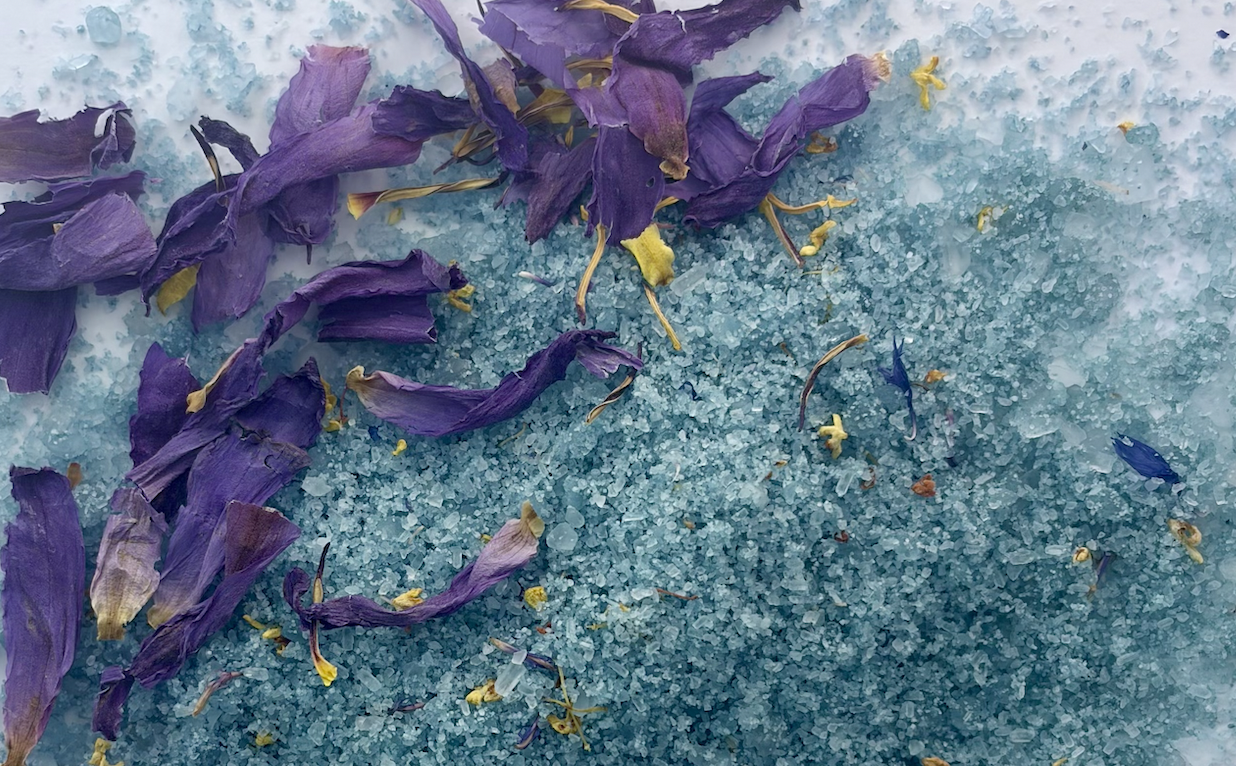
Blue lotus petals (Bath Brew · Shower Steamer)
Nelumbo nucifera — placed with intention above the botanical field in the jar, and whole within the shower sachet. Never crushed, never mixed. Blue lotus has been sacred in ancient Egyptian and Hindu traditions for millennia, associated with the sun, with consciousness, with what emerges from the water toward the light. It is the drama element of this blend in both formats — a single gesture that belongs to the register of vision and elevation. It should feel like it was set there by someone who thought about it.
The scent blend
Ten plants — cypress, frankincense sacra, juniper berry, bergamot, lavender, clary sage, labdanum, ho wood, jasmine absolute, and sandalwood — carried in a plant-derived base. Bath and shower share the core; labdanum is present in the bath but absent from the shower.
Cypress leads — dry, coniferous, the scent of altitude. Frankincense sacra grounds it with deep resinous clarity, lifting rather than weighing. Juniper berry amplifies the cypress direction, adding a dry-green body that extends the high-country register. Bergamot lifts the top just enough to prevent the blend from tipping heavy. Lavender is deliberately kept low — a quiet presence that protects the distinction from Let Go, which lavender owns. Clary sage is a ghost note, barely there, a hint of something herbal and expansive beneath the conifer. Ho wood adds a quiet linalool warmth, a softener in the base. Labdanum brings a dry, resinous complexity — the smell of sun-warmed Mediterranean rock — present in the bath and body formats, removed from the shower where brief steam exposure wouldn't develop it. Jasmine absolute arrives in the dry-down of the body oil and butter — its job here is not to be jasmine but to keep the blend from reading austere. Sandalwood slows the evaporation and deepens the frankincense.
Lapis lasuli
A deep blue metamorphic rock — not a single mineral but a combination of lazurite, calcite, and pyrite — mined in the same mountains of northeastern Afghanistan for over six thousand years.
Lapis is one of the oldest traded luxury materials on earth. It was ground into ultramarine pigment for Renaissance paintings, placed in Egyptian burial masks, used as medicine and oracle and adornment across the ancient world. The gold flecks of pyrite running through it are not impurities — they are the stone's own internal light. In a jar built around vision and clarity, lapis is the stone that has accompanied human seeing the longest. It knows what it's doing here.
FULL INGREDIENTS LIST
VISION Ritual Bath Brew
1
Maris Sal, Magnesium Sulfate, Sodium Chloride, Kaolin, Centaurea Cyanus Flower, Osmanthus Fragrans Flower, Nelumbo Nucifera Flower, Cupressus Sempervirens Oil, Boswellia Sacra Oil, Juniperus Communis Fruit Oil, Citrus Bergamia Peel Oil Expressed, Lavandula Angustifolia Oil, Salvia Sclarea Oil, Cistus Ladaniferus Oil, Cinnamomum Camphora Leaf Oil, Caprylyl Glucoside
VISION Ritual Shower Steamer
2
Magnesium Sulfate, Sodium Chloride, Kaolin, Centaurea Cyanus Flower, Osmanthus Fragrans Flower, Nelumbo Nucifera Flower, Cupressus Sempervirens Oil, Boswellia Sacra Oil, Juniperus Communis Fruit Oil, Citrus Bergamia Peel Oil Expressed, Lavandula Angustifolia Oil, Salvia Sclarea Oil, Cinnamomum Camphora Leaf Oil, Caprylyl Glucoside
VISION Body Oil
3
Prunus Amygdalus Dulcis Oil, Prunus Armeniaca Kernel Oil, Persea Gratissima Oil, Simmondsia Chinensis Seed Oil, Argania Spinosa Kernel Oil, Tocopherol, Cupressus Sempervirens Oil, Boswellia Sacra Oil, Juniperus Communis Fruit Oil, Citrus Bergamia Peel Oil Expressed, Lavandula Angustifolia Oil, Salvia Sclarea Oil, Cistus Ladaniferus Oil, Cinnamomum Camphora Leaf Oil, Jasminum Sambac Flower/Leaf Extract, Santalum Album Oil
VISION Body Butter
4
Theobroma Cacao Seed Butter, Butyrospermum Parkii Butter, Cetearyl Olivate, Sorbitan Olivate, Glycerin, Prunus Amygdalus Dulcis Oil, Cupressus Sempervirens Oil, Boswellia Sacra Oil, Juniperus Communis Fruit Oil, Citrus Bergamia Peel Oil Expressed, Lavandula Angustifolia Oil, Salvia Sclarea Oil, Cistus Ladaniferus Oil, Cinnamomum Camphora Leaf Oil, Jasminum Sambac Flower/Leaf Extract, Santalum Album Oil