EMBODY: Meet the Allies
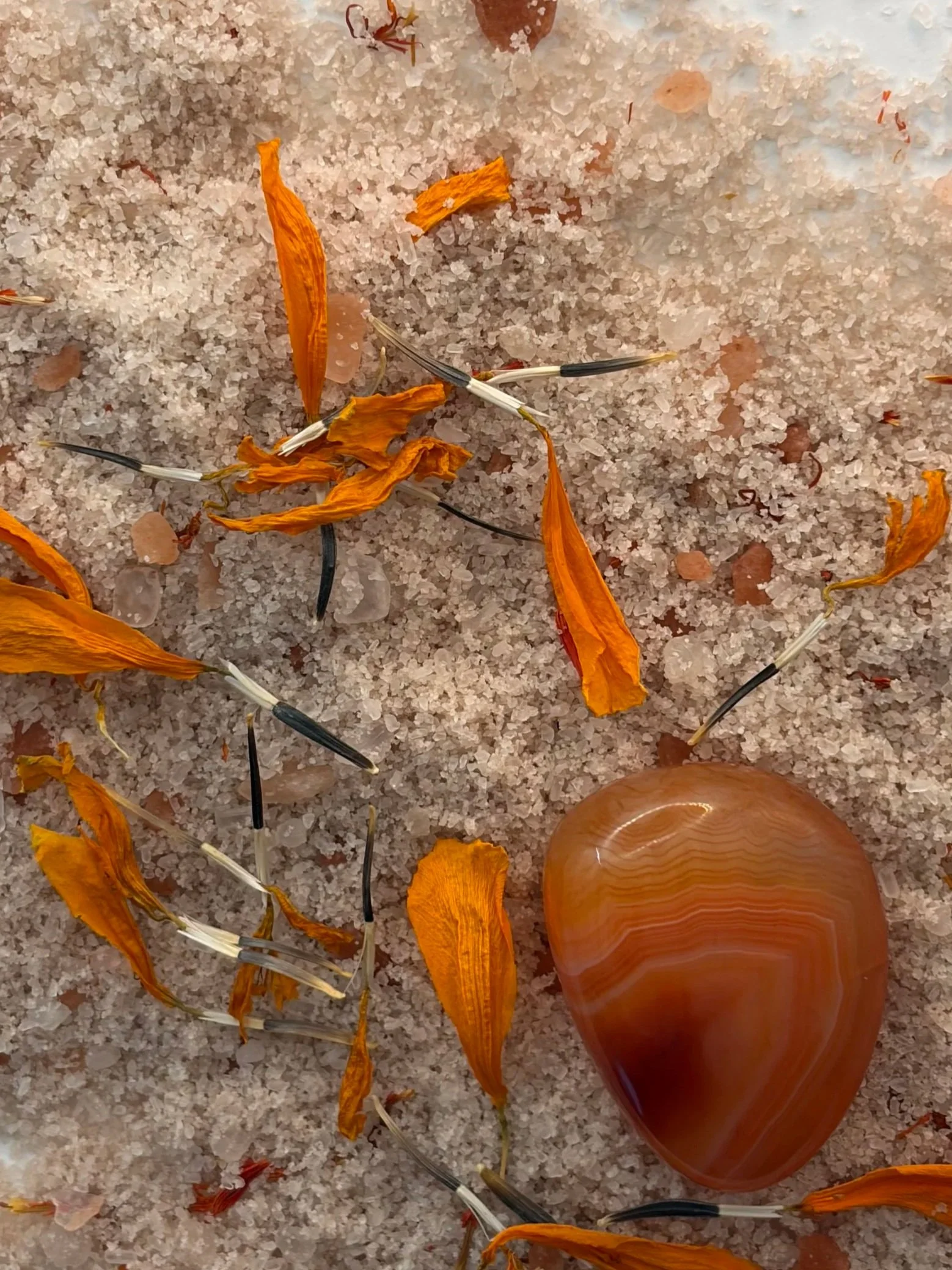
Dead Sea salt and Himalayan pink salt (Bath Brew)
Dead Sea coarse is geological — heavy, textured, grey-tan, mineral-dense in a way that most salts aren't. Dead Sea fine threads through it, filling the field. The Himalayan pink is an accent, not a base: individual terracotta-pink crystals catching the light among the grey. This is not a pink salt blend. It is a grey salt blend with warmth threaded through it — which is a different thing entirely, and the reason the jar reads as grounded rather than decorative. Dendritic salt carries the scent until the moment you pour.
Fine sea salt, Epsom salt, Himalayan pink salt, and dendritic salt (Shower Steamer)
The shower base carries the Himalayan pink through into this format — the warm terracotta accent present even in brief exposure. Coarse sea salt slows the dissolve; dendritic holds the scent through the steam.
Brazilian purple clay
A rare kaolin clay from the volcanic soils of central Brazil, its deep purple color formed entirely by iron oxide and magnesium — no dyes, no additives. What you see is what the earth made. In the jar it creates deliberate chromatic tension — purple clay against orange safflower and warm carnelian. Not harmony. Contrast. The kind that makes both colors more vivid than they'd be alone. In the water it releases a warm plum-amber register unlike anything else in the line. (In the Shower Steamer, the purple clay floor dissolves into a warm amber haze.)
Calendula petals
Calendula officinalis — the pot marigold, cultivated as a healing plant across Europe and the Mediterranean for centuries. One of the most well-documented skin-soothing plants in Western herbal tradition. Here it is the warm amber-gold ground that everything else sits on — the botanical register of completion, present and unhurried.
Safflower petals
Carthamus tinctorius — one of humanity's oldest cultivated plants, grown for dye, oil, and medicine for over four thousand years across Asia, the Middle East, and Africa. Safflower petals are deep red-orange, a color contrast against the amber calendula that creates visual depth in the jar. In the water they release a warm terracotta tint. It has colored the robes of Buddhist monks and been found in ancient Egyptian tombs. A plant with an extraordinarily long relationship with human beings, still doing its work here.
Marigold (tagetes) petals (Bath Brew · Shower Steamer)
Tagetes erecta — deep amber-gold, intensely pigmented, aromatic even dried. Marigold has been sacred in Hindu, Aztec, and Day of the Dead traditions — a flower associated with the threshold between worlds, used in ceremony and offering across cultures with no contact with each other. In the jar it is the drama element: the warm gold that catches the eye before anything else does. In the water, it deepens the amber register of the calendula and safflower. Everything in this jar is gold and earth. The marigold is the loudest statement of that.
The scent blend
Ten ingredients, five thousand years of use between them. This blend doesn't perform. It settles.
Frankincense sacra opens — breath-clearing, resinous, the oldest sacred material in the formula. Myrrh moves alongside it, as it always has — bitter, transformative, the darker half. Benzoin adds quiet sweetness to keep the resins from tipping austere. Cedarwood Atlas is the woody spine that holds everything in structure. Amyris anchors the bath formula with additional warm-wood depth, quieter than cedarwood, a second layer of base. Ylang ylang hovers deliberately low — floral without sweetness, a presence rather than a note. Davana adds a warm, fruited complexity unique in the line — anisic and rich, it deepens the resinous register without citrus. Marigold absolute brings sacred gold in trace — present in both bath and shower. Blue lotus absolute arrives in the bath as a waxy, aquatic thread barely above the surface — Egyptian ceremonial register, the thing that shifts the character of everything around it without announcing itself. Spikenard sits at the very base — rooty, animalic, ancient in a way that predates ceremony itself.
The shower formula runs leaner: myrrh removed, amyris removed, blue lotus removed. Opoponax enters in their place — a sweet, balsamic resin that performs better in brief steam than myrrh, carrying the sacred-resinous register without the medicinal edge. Vanilla oleoresin threads through both formats, warm and embodied.
The body oil and butter carry their own composition: osmanthus absolute for peach-leather warmth, tonka absolute for sun-warmed skin, sandalwood for the long slow dry-down. No citrus. No green. Pure sacred-warm-ancient from first breath to last.
Carnelian (Bath Brew only)
A deep red-orange variety of chalcedony, its color shaped by iron oxide. One of the oldest stones used ornamentally by human beings — found in Neolithic graves, ancient Egyptian amulets, and across nearly every ancient culture. Carnelian echoes the safflower and the Himalayan accent crystals — same color family, different material. It is warm in the hand in a way that cool stones aren't. It belongs at the end of the arc, where the work is integration rather than release or clarity. It is the stone you hold when you're ready to be back in your body.
FULL INGREDIENTS LIST
EMBODY Ritual Bath Brew
1
Maris Sal, Sodium Chloride, Kaolin, Calendula Officinalis Flower, Carthamus Tinctorius Flower, Tagetes Erecta Flower, Amyris Balsamifera Bark Oil, Boswellia Sacra Oil, Vanilla Planifolia Fruit Extract, Commiphora Myrrha Oil, Styrax Benzoin Resin Extract, Cedrus Atlantica Bark Oil, Cananga Odorata Flower Oil, Anthemis Mixta Flower Oil, Tagetes Erecta Flower Oil, Nymphaea Caerulea Flower Extract, Nardostachys Jatamansi Root Oil, Caprylyl Glucoside
EMBODY Ritual Shower Steamer
2
Magnesium Sulfate, Sodium Chloride, Kaolin, Calendula Officinalis Flower, Carthamus Tinctorius Flower, Tagetes Erecta Flower, Boswellia Sacra Oil, Vanilla Planifolia Fruit Extract, Styrax Benzoin Resin Extract, Cedrus Atlantica Bark Oil, Cananga Odorata Flower Oil, Commiphora Erythraea Oil, Anthemis Mixta Flower Oil, Tagetes Erecta Flower Oil, Nardostachys Jatamansi Root Oil, Caprylyl Glucoside
EMBODY Body Oil
3
Prunus Amygdalus Dulcis Oil, Prunus Armeniaca Kernel Oil, Persea Gratissima Oil, Simmondsia Chinensis Seed Oil, Argania Spinosa Kernel Oil, Tocopherol, Boswellia Sacra Oil, Commiphora Myrrha Oil, Styrax Benzoin Resin Extract, Cedrus Atlantica Bark Oil, Osmanthus Fragrans Flower Extract, Tagetes Erecta Flower Oil, Nymphaea Caerulea Flower Extract, Santalum Album Oil, Nardostachys Jatamansi Root Oil, Dipteryx Odorata Seed Extract
EMBODY Body Butter
4
Theobroma Cacao Seed Butter, Butyrospermum Parkii Butter, Cetearyl Olivate, Sorbitan Olivate, Glycerin, Prunus Amygdalus Dulcis Oil, Boswellia Sacra Oil, Commiphora Myrrha Oil, Styrax Benzoin Resin Extract, Cedrus Atlantica Bark Oil, Osmanthus Fragrans Flower Extract, Tagetes Erecta Flower Oil, Nymphaea Caerulea Flower Extract, Santalum Album Oil, Nardostachys Jatamansi Root Oil, Dipteryx Odorata Seed Extract